
window.dataLayer = window.dataLayer || []; function gtag(){dataLayer.push(arguments);} gtag('js', new Date()); gtag('config', 'UA-156569540-1');

Mid-Year is a Good Time for a Financial Checkup

The first half of the year is coming to a close. Conducting a mid-year financial analysis can be helpful. Here are some ways to make sure that your financial situation is continuing on the right path.

Reassess your financial goals

At the beginning of the year, you may have set financial goals geared toward improving your financial situation. Perhaps you wanted to save more, spend less, or reduce your debt. How much progress have you made? If your income, expenses, and life circumstances have changed, you may need to rethink your priorities. Review your financial statements and account balances to determine whether you need to make any changes to keep your financial plan on track.

Take a look at your taxes

Completing a mid-year estimate of your tax liability may reveal new tax planning opportunities. You can use last year’s tax return as a basis, then factor in any anticipated adjustments to your income and deductions for this year. Check your withholding, especially if you owed taxes or received a large refund. Doing that now, rather than waiting until the end of the year, may help you avoid owing a big tax bill next year or overpaying taxes and giving Uncle Sam an interest-free loan. You can check your withholding by using the IRS Tax Withholding Estimator at irs.gov. If necessary, adjust the amount of federal or state income tax withheld from your paycheck by filing a new Form W-4 with your employer.

Check your retirement savings

If you’re still working, look for ways to increase retirement plan contributions. For example, if you receive a pay increase this year, you could contribute a higher percentage of your salary to your employer-sponsored retirement plan, such as a 401(k), 403(b), or 457(b) plan. For 2021, the contribution limit is $19,500, or $26,000 if you’re age 50 or older. If you are close to retirement or already retired, take another look at your retirement income needs and whether your current investment and distribution strategy will provide the income you will need.

Evaluate your insurance coverage

What are the deductibles and coverage limits of your homeowners/renters insurance policies? How much disability or life insurance coverage do you have? Your insurance needs can change over time. As a result, you’ll want to make sure your coverage has kept pace with your income and family/personal circumstances. The cost and availability of life insurance depend on factors such as age, health, and the type and amount of insurance purchased.

Ask questions

Finally, you should also ask yourself the following questions as part of your mid-year financial checkup:

  • Do you have enough money in your emergency fund to cover unexpected expenses?
  • Do you have money left in your flexible spending account?
  • Are your beneficiary designations up-to-date?
  • Have you checked your credit score recently?
  • Do you need to create or update your will?
  • When you review your portfolio, is your asset allocation still in line with your financial goals, time horizon, and tolerance for risk? Are any changes warranted?Asset allocation is a method used to help manage investment risk; it does not guarantee a profit or protect against investment loss. All investing involves risk, including the possible loss of principal, and there is no guarantee that any investment strategy will be successful.

Doing that mid-year checkup will help you maintain course and achieve your goals. The team at Blakely Financial is always here to help, so call us today!


This material has been provided for general informational purposes only and does not constitute either tax or legal advice. Although we go to great lengths to ensure our information is accurate and useful, we recommend you consult a tax preparer, professional tax advisor, or lawyer.

Engage with the entire Blakely Financial team at WWW.BLAKELYFINANCIAL.COM to see what other financial tips we can provide for your financial well-being.

Blakely Financial, Inc. is an independent financial planning and investment management firm that provides clarity, insight, and guidance to help our clients attain their financial goals.

Securities and advisory services offered through Commonwealth Financial Network, Member FINRA/SIPC, a Registered Investment Adviser.


Tidy Up Your Financial Clutter

Tidy Up Financial Clutter

Presented by Emily Promise

Each year, people embark on the journey of tidying up their homes. They break out the gloves and the lemon-scented cleaners and begin emptying their refrigerators, clearing out their closets, and scrubbing their baseboards. But, they often skip some of the essential items – their financial clutter. 

It’s time to do some spring cleaning for your finances. Not sure where to start? Here are three quick tips to eliminate and organize your financial clutter:

Throw out old paperwork, statements, etc.

We all think that someday we will need all the documents we have shoved into a filing cabinet. But how many times have you ever returned those documents? I’ll venture a guess that you haven’t. Some items, such as tax documents, are essential to hold onto for a given time, but many others can be safely discarded. We have a helpful resource to reference what to keep and what to shred. 

Make a list of your financial accounts – all assets and liabilities.

Take time to review this list, cancel unused membership/subscriptions, close out old credit cards, and consolidate any old 401(k)s or investment accounts. Having less to keep track of will give you more energy and time to devote to what’s left, and you may even be able to set aside the savings into your investment accounts or emergency funds! 

Create a central location for all items you truly need to keep

If documents, such as Social Security cards, marriage certificates, etc., are essential to keep, it is vital to know where they can be located when the time comes to access these items. Therefore, identify or create one safe location where all these critical documents are stored. Then, you and anyone else who may need to access them in an emergency know how to locate and identify them readily. 

While we all have some degree of financial clutter, these steps should set you up for success in avoiding and alleviating some in your own home.  


This material has been provided for general informational purposes only and does not constitute either tax or legal advice. Although we go to great lengths to ensure our information is accurate and useful, we recommend you consult a tax preparer, professional tax advisor, or lawyer.

Engage with the entire Blakely Financial team at WWW.BLAKELYFINANCIAL.COM to see what other financial tips we can provide towards your financial well-being.

Blakely Financial, Inc. is an independent financial planning and investment management firm that provides clarity, insight, and guidance to help our clients attain their financial goals.

Securities and advisory services offered through Commonwealth Financial Network, Member FINRA/SIPC, a Registered Investment Adviser.
BFI April Blog • Social Security Benefits

Working While Receiving Social Security Benefits

The COVID-19 recession and the continuing pandemic pushed many older workers into retirement earlier than anticipated. More than 50% of Americans aged 55 and older said they were retired in Q3 2021, up from about 48% two years earlier, before the pandemic.1

For people age 62 and older, retiring from the workforce often means claiming Social Security benefits. But what happens if you decide to go back to work? With the job market heating up, there are opportunities for people of all ages to return to the workforce. Or, to look at it another way: What happens if you work and want to claim Social Security benefits while staying on your job?

Retirement Earnings Test

Some people may think they can’t work — or shouldn’t work — while collecting Social Security benefits. But that’s not the case. First, however, it’s essential to understand how the retirement earnings test (RET) could affect your benefits.

  • The RET applies only if you are working and receiving Social Security benefits before reaching full retirement age (FRA). After reaching full retirement age, any earnings do not affect your Social Security benefit. Your FRA is based on your birth year: age 66 if born in 1943 to 1954; age 66 & 2 months to 66 & 10 months if born in 1955 to 1959; age 67 if born in 1960 or later.
  • If you are under full retirement age for the entire year in which you work, $1 in benefits will be deducted for every $2 in gross wages or net self-employment income above the annual exempt amount ($19,560 in 2022). The RET does not apply to income from investments, pensions, or retirement accounts.
  • A monthly limit applies during the year you file for benefits ($1,630 in 2022) unless you are self-employed and work more than 45 hours per month in your business (15 hours in a highly skilled industry). So, for example, if you file for benefits starting in July, you could earn more than the annual limit from January to June and still receive full benefits if you do not make more than the monthly limit from July through December.
  • In the year you reach full retirement age, the reduction in benefits is $1 for every $3 earned above a higher annual exempt amount ($51,960 in 2022 or $4,330 per month if the monthly limit applies). Starting in the month you reach full retirement age, there is no limit on earnings or reduction in benefits.
  • The Social Security Administration may withhold benefits as soon as it determines that your earnings are on track to surpass the exempt amount. After that, the estimated amount will typically be deducted from your monthly benefit in full. (See example.)
  • The RET also applies to spousal, dependent, and survivor benefits if the spouse, dependent, or survivor works before full retirement age. Regardless of a spouse’s or dependent’s age, the RET may reduce a spousal or dependent benefit based on the benefit of a worker who is subject to the RET.

Back to Work

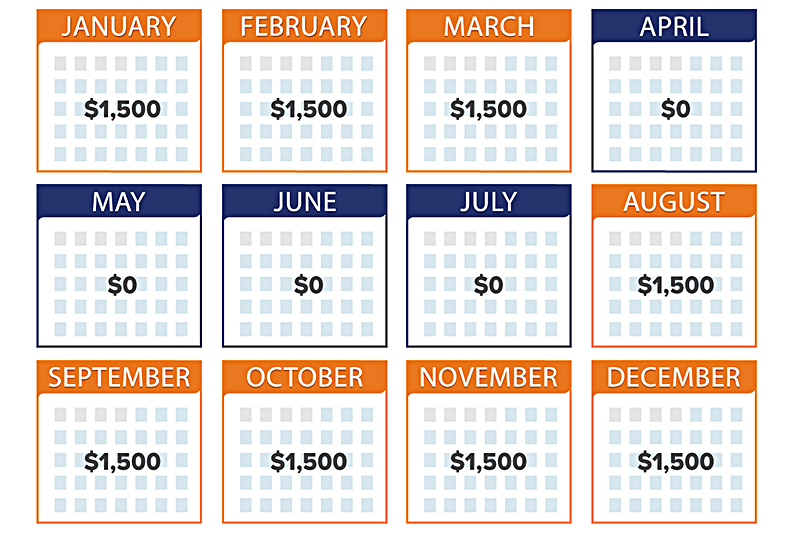
In this hypothetical example, Fred claimed Social Security in 2021 at age 62, and he was entitled to a $1,500 monthly benefit as of January 2022. However, Fred returned to work in April 2022 and is on track to earn $31,560 for the year — $12,000 above the $19,560 RET exempt amount. Thus, $6,000 ($1 for every $2 above the exempt amount) in benefits will be deducted. Assuming that the Social Security Administration (SSA) became aware of Fred’s expected earnings before he returned to work, benefits might be paid.
In practice, benefits may be withheld earlier in the year or retroactively, depending on when the SSA becomes aware of earnings.

The RET might seem like a stiff penalty, but the deducted benefits are not lost. Your Social Security benefit amount is recalculated after you reach full retirement age. For example, if you claimed benefits at age 62 and forfeited the equivalent of 12 months’ worth of benefits by the time you reached full retirement age, your benefit would be recalculated as if you had claimed it at age 63 instead of 62. You would receive this higher benefit for the rest of your life, so you could receive substantially more than the amount that was withheld. There is no adjustment for lost spousal benefits or lost survivor benefits based on having a dependent child.

If you regret taking your Social Security benefit before reaching full retirement age, you can apply to withdraw benefits within 12 months of the original claim. You must repay all benefits received on your claim, including any spousal or dependent benefits. This option is available only once in your lifetime.

1) Pew Research Center, November 4, 2021


This material has been provided for general informational purposes only and does not constitute either tax or legal advice. Although we go to great lengths to make sure our information is accurate and useful, we recommend you consult a tax preparer, professional tax advisor, or lawyer.

Engage with the entire Blakely Financial team at WWW.BLAKELYFINANCIAL.COM to see what other expert advice we can provide towards your financial well-being.

ROBERT BLAKELY, CFP® is a financial advisor with BLAKELY FINANCIAL, INC. located at 1022 Hutton Ln., Suite 109, High Point, NC 27262. He is the founder and president of Blakely Financial, Inc.

Blakely Financial, Inc. is an independent financial planning and investment management firm that provides clarity, insight, and guidance to help our clients attain their financial goals.

Securities and advisory services offered through Commonwealth Financial Network, Member FINRA/SIPC, a Registered Investment Adviser.

Diversification and asset allocation programs do not assure a profit or protect against loss in declining markets, and cannot guarantee that any objective or goal will be achieved.

Baseball Lessons To Change Up Your Finances

Presented by STEPHEN LAFRANCE, CFP®, MBA

Baseball stadiums are filled with optimists. Fans start each new season hoping that this year could finally be the year, even if last year ended severely. After all, teams rally mid-season, curses are broken, and even underdogs sometimes make it to the World Series. As Yogi Berra famously put it, “It ain’t over till it’s over.”1 Here are a few lessons from America’s pastime that might inspire you to take a fresh look at your finances.

Proceed One Base at a Time

There’s nothing like seeing a home run light up the scoreboard, but games are often won by singles and doubles that put runners in scoring position through a series of hits. The one-base-at-a-time approach takes discipline, something you can apply to your finances. What are your financial goals? Do you know how much money comes in and how much goes out? Are you saving regularly for retirement or a child’s college education? Answering some fundamental questions will help you understand where you are now and help you decide where you want to go.

Cover Your Bases

Baseball players must be positioned and prepared to make a play at the base. So what can you do to help protect your financial future if life throws you a curveball? First, try to prepare for those “what ifs.” For example, you could buy the insurance coverage you need to help make sure your family is protected. And you could set up an emergency account that you can tap instead of dipping into your retirement funds or using a credit card when an unexpected expense arises.

Take Me Out to the Ball Game

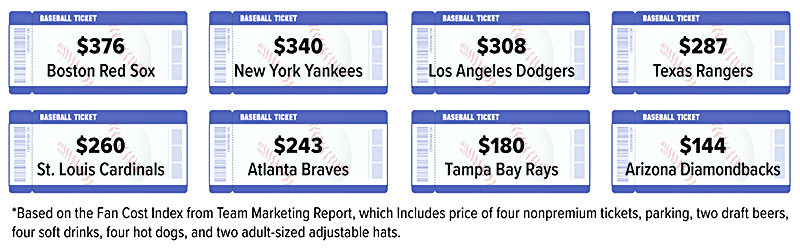
The average cost of taking a family of four to a Major League Baseball game during the 2021 season was $253. Prices varied across the league, with Red Sox fans paying the most and Diamondbacks fans paying the least.*

Source: The Athletic, 2021

Expect to Strike Out

Fans may have trouble seeing strikeouts in a positive light, but every baseball player knows that striking out is a big part of the game. Striking out is much more common than getting hits. The record for the highest career batting average record is .366, held by Ty Cobb.2 As Ted Williams once said, “Baseball is the only field of endeavor where a man can succeed three times out of ten and be considered a good performer.”3

So how does this apply to your finances? As Hank Aaron put it, “Failure is a part of success.” 4 If you’re prepared for the misses and the hits, you can avoid reacting emotionally rather than rationally when things don’t work out according to plan. For example, when investing, you have no control over how the market will perform, but you can decide what to invest in and when to buy and sell, according to your investment goals and risk tolerance. In the words of longtime baseball fan Warren Buffett, “What’s nice about investing is you don’t have to swing at every pitch.”5

See Every Day as a New Ball Game

When the trailing team ties the score (often unexpectedly), the announcer shouts, “It’s a whole new ball game!” 6

Whether your investments haven’t performed as expected, you’ve spent too much money, or you haven’t saved enough, there’s always hope if you’re willing to learn from what you’ve done right and what you’ve done wrong. Hall of Famer Bob Feller may have said it best. “Every day is a new opportunity. You can build on yesterday’s success or put its failures behind you and start again. That’s the way life is, with a new game every day, and that’s the way baseball is.”7


All investing involves risk, including the possible loss of principal. In addition, there is no guarantee that any investment strategy will be successful.

1, 3-4, 6-7) BrainyQuote.com

2) ESPN.com

5) quotefancy.com


This material has been provided for general informational purposes only and does not constitute either tax or legal advice. Although we go to great lengths to ensure our information is accurate and useful, we recommend you consult a tax preparer, professional tax advisor, or lawyer.

Engage with the entire Blakely Financial team at WWW.BLAKELYFINANCIAL.COM to see what other financial tips we can provide towards your financial well-being.

STEPHEN LAFRANCE, CFP®, MBA is a financial advisor with BLAKELY FINANCIAL, INC. located at 1022 Hutton Ln., Suite 109, High Point, NC 27262. 336-885-2530.

Blakely Financial, Inc. is an independent financial planning and investment management firm that provides clarity, insight, and guidance to help our clients attain their financial goals.

Securities and advisory services offered through Commonwealth Financial Network, Member FINRA/SIPC, a Registered Investment Adviser.
Raising Money-Smart Teens

As teens look forward to summer activities, especially those that cost money, the next few months might present an ideal opportunity to help them learn about earning, spending, and saving. Here are a few age-based tips.

Younger Teens

Recently, apps have proliferated to help parents teach tweens and teens basic money management skills. For example, some money apps allow parents to provide an allowance or pay their children for completing chores by transferring money to companion debit cards. Many offer education on the basics of investing. Others allow children to choose from a selection of charities for donations. Some even allow parents to track when and where debit-card transactions are processed and block specific retailers or types of businesses.

Most apps typically charge either a monthly or an annual fee (although some offer limited services for free), so it’s best to shop around and check reviews.

Older Teens

Many teens get their first real-life work experience during the summer months, presenting a variety of teachable moments.

Review payroll deductions together. A quick review can be an eye-opening education in deductions for federal and state income taxes and Social Security and Medicare taxes.

Open checking and savings accounts. Many banks allow teens to open a checking account with a parent co-signer. Encouraging teens to have a portion of their earnings automatically transferred to a companion savings account helps them learn the importance of “paying yourself first.” They might even be encouraged to write a small check or two to help cover the expenses they help incur, such as the Internet, cell phone, food, gas, or auto insurance.

Consider opening a Roth account. A teen with earned income could be eligible to contribute to a Roth IRA set up by a parent — a great way to introduce the concept of retirement saving. Because Roth contributions are made on an after-tax basis, they can be withdrawn at any time, for any reason.

Roth IRA earnings can be withdrawn free of taxes as long as the distribution is “qualified”; it occurs after a five-year holding period and the account holder reaches age 59½, dies, or becomes disabled. Nonqualified earnings distributions are taxed as ordinary income and subject to a 10% early-withdrawal penalty; however, if the account is held for at least five years, penalty-free distributions can be taken for a first-time home purchase and to help pay for college expenses, which may be helpful in young adulthood. (Regular income taxes will still apply.)


This material has been provided for general informational purposes only and does not constitute either tax or legal advice. Although we go to great lengths to make sure our information is accurate and useful, we recommend you consult a tax preparer, professional tax advisor, or lawyer.

Engage with the entire Blakely Financial team at WWW.BLAKELYFINANCIAL.COM to see what other specialized advice we can provide towards your financial well-being.

EMILY PROMISE is a financial advisor with BLAKELY FINANCIAL, INC. located at 1022 Hutton Ln., Suite 109, High Point, NC 27262 and can be reached at (336) 885-2530.

Blakely Financial, Inc. is an independent financial planning and investment management firm that provides clarity, insight, and guidance to help our clients attain their financial goals.

Securities and advisory services offered through Commonwealth Financial Network, Member FINRA/SIPC, a Registered Investment Adviser.

Prepared by Commonwealth Financial Network®

The Truth About Buy Now Pay Later BNPL Blakely Financial

When Buying Is Easy, Paying Later Can Be a Problem

Presented by Emily Promise

If you shop online, you might have noticed a growing number of buy now, pay later (BNPL) services that offer the option to spread out the payments on your purchases. For example, buyers who make one partial payment upfront and agree to several additional interest-free installments can receive their orders immediately. This is a crucial difference from the layaway plans of the past in which shoppers had to wait until they paid the balance in full to take their goods home. Many stores discontinued layaway plans in the 1980s when credit cards became widespread.

BNPL plans are more popular with younger consumers trying to stretch their paychecks, partly because they are more comfortable shopping online (and particularly on smartphones). At first glance, it may seem like a worthwhile convenience, but there are good reasons to think twice before committing to installment purchases.

Credit Is Credit

BNPL plans are essentially point-of-sale loans; applying for financing is quick and easy, which seems like a plus when time is tight.

However, speedy access to credit also provides instant gratification and allows for more impulse buying. As a result, it might tempt you to overspend on things you don’t need and probably wouldn’t buy if you had to save up and/or pay 100% of the cost upfront. And if you make a lot of smaller purchases across multiple services, it may be harder to keep track of how much you are spending.

Too Good To Be True?

One criticism of BNPL services is that they make it easier for consumers to fall into debt. As with credit cards, you would face financial consequences such as late fees and/or high-interest rates if you encounter a financial setback and can’t pay the installments on schedule.

Another point to consider is that credit-card companies report on-time payments to the credit bureaus, so using credit cards responsibly can help you build a positive credit history. In contrast, some BNPL lenders may not bother to report on-time payments — though they will indeed report missed payments and collections. So before you use any BNPL service, read the fine print carefully to make sure you understand the terms and conditions and the company’s credit reporting policies.


This material has been provided for general informational purposes only and does not constitute either tax or legal advice. Although we go to great lengths to ensure our information is accurate and useful, we recommend you consult a tax preparer, professional tax advisor, or lawyer.

Engage with the entire Blakely Financial team at WWW.BLAKELYFINANCIAL.COM to see what other financial tips we can provide towards your financial well-being.

Blakely Financial, Inc. is an independent financial planning and investment management firm that provides clarity, insight, and guidance to help our clients attain their financial goals.

Securities and advisory services offered through Commonwealth Financial Network, Member FINRA/SIPC, a Registered Investment Adviser.

Tax Season Scam Alert Warning Blakely Financial

Tax Season Scams Alert

Presented by Robert Blakely, CFP™ 

With tax season upon us, many of us are busy gathering the appropriate documents, meeting with CPAs, and ensuring to meet all relevant tax deadlines. But in all the hustle and bustle, taxpayers also need to keep an eye on the risks, especially tax season scams. Scammers get savvier with strategies to access other people’s personal information and money each year. To help you steer clear of this year’s top scams, learn red flags to watch out for—along with some timely tax-filing reminders.

“Ghost” Tax Return Preparers

One truly frightening scam haunting taxpayers is the ghost preparer. These preparers remain hidden from the IRS by not signing returns, making the returns appear to be self-prepared. In cases where the individual e-files, the ghost preparer will refuse to sign the return digitally. The result can be disastrous for taxpayers, leaving them open to serious filing mistakes, tax fraud, penalties, and audits by the IRS.

Red flags. To help avoid this issue, be aware of red flags surrounding ghost preparers. They usually:

  • Don’t sign the return with a Preparer Tax Identification Number (PTIN) (The PTIN is required by law for anyone who is paid to prepare or assist in preparing a federal tax return.)
  • Lure clients in with the promise of big refunds (Unfortunately, these scammers will resort to claiming fake deductions to boost the size of the refund.)
  • Require payment in cash
  • Have refunds directed into their bank accounts, not the taxpayer’s

Pro-tip. If you’re looking for someone to prepare your taxes, the IRS has an excellent online resource that offers a tool for checking your tax preparer’s credentials and tips for avoiding potential tax scammers. No matter who prepares your return, it’s essential to review it carefully, including the routing and banking numbers if you’re receiving your refund via direct deposit.

New Round of COVID-19 Scams

As the coronavirus continues to spread, so do scams, unfortunately. Criminals often try to exploit taxpayers during times of uncertainty, and this pandemic has been no exception. The latest COVID-19 scams center around the most recent round of stimulus payments. They have taken on a few forms, all with the singular goal of stealing taxpayers’ money and personal information.

 Red flags. The IRS Criminal Investigation Division has compiled a list of the latest COVID-19 scams. Here’s what to be on the lookout for:

  •  Text messages asking you to disclose bank account information to receive the $1,200 economic stimulus
  • Emails, letters, and social media messages that use “coronavirus,” “COVID-19,” and “stimulus” in different ways, requesting personal information and financial account information (e.g., account numbers and passwords)
  • Sale of fake at-home COVID-19 test kits
  • Fake donation requests for individuals, groups, and areas heavily affected by COVID-19
  • “Opportunities” to invest in companies developing COVID-19 vaccines, which also promise these companies will drastically increase in value as a result

 Pro-tip. If you receive unsolicited emails or social media attempts to gather your personal information and appear to be from the IRS or an organization linked to the IRS, forward the message to phishing@irs.gov.

Online Identity Theft

One of the most common tax scams remains personal identity theft, particularly rampant during tax season. Why? Scammers can file phony tax returns and steal refunds by accessing unsuspecting taxpayers’ social security numbers, addresses, and birth dates. The worst part is this can all be done before the victims even know their identities have been stolen.

Red flags. So, what can you do to help ensure that someone doesn’t file a return in your name? Know the warning signs of this pervasive scam. If you receive an IRS notice regarding any of the following, contact the IRS immediately: 

  • a duplicate return
  • that you received wages from somewhere you never worked
  • you owe additional taxes or that the IRS will offset your tax refund
  • collection actions are being taken against you for a year you did not file a tax return
  • As noted above, ensure that your tax preparer has the appropriate credentials.
  • Unless there is a valid reason, don’t give out your social security number—and always know who to whom you’re giving it.

Pro-tip. The best way to avoid this scam is to file your taxes early before a scammer can access your information. You might also think about proactively using an Identity Protection PIN (IP PIN) to protect yourself from identity theft. The IP PIN is a six-digit number known only to you and the IRS that you can use to help the IRS verify your identity when a paper or electronic tax return is filed.

Never Has the IRS Ever . . .

One of the most important things to know is how the IRS does (and doesn’t) contact taxpayers regarding tax scams. Here are some things the IRS won’t do:

  • Demand that you pay taxes without the opportunity to question or appeal the amount it says you owe
  • Call to demand you make an immediate payment using a specific method (e.g., prepaid debit card, gift card, or wire transfer)
  • Threaten to bring in local police, immigration officers, or other law enforcement to arrest you for not paying (Threats are a common tactic used by scammers.)

If you get a call or email that sounds like any of the above, it’s likely a scam. For steps to take if you suspect fraudulent tax activity, visit the IRS’s Report Phishing and Online Scams page.

Scams Don’t End with Tax Season.

Although the focus here is on tax season, we would all be wise to remember that new scams pop up every day, year-round. So, keep your personal information safe and be on the lookout for potential scams.


This material has been provided for general informational purposes only and does not constitute either tax or legal advice. Although we go to great lengths to ensure our information is accurate and useful, we recommend you consult a tax preparer, professional tax advisor, or lawyer.


###


© 2021 Commonwealth Financial Network®