window.dataLayer = window.dataLayer || []; function gtag(){dataLayer.push(arguments);} gtag('js', new Date()); gtag('config', 'UA-156569540-1');
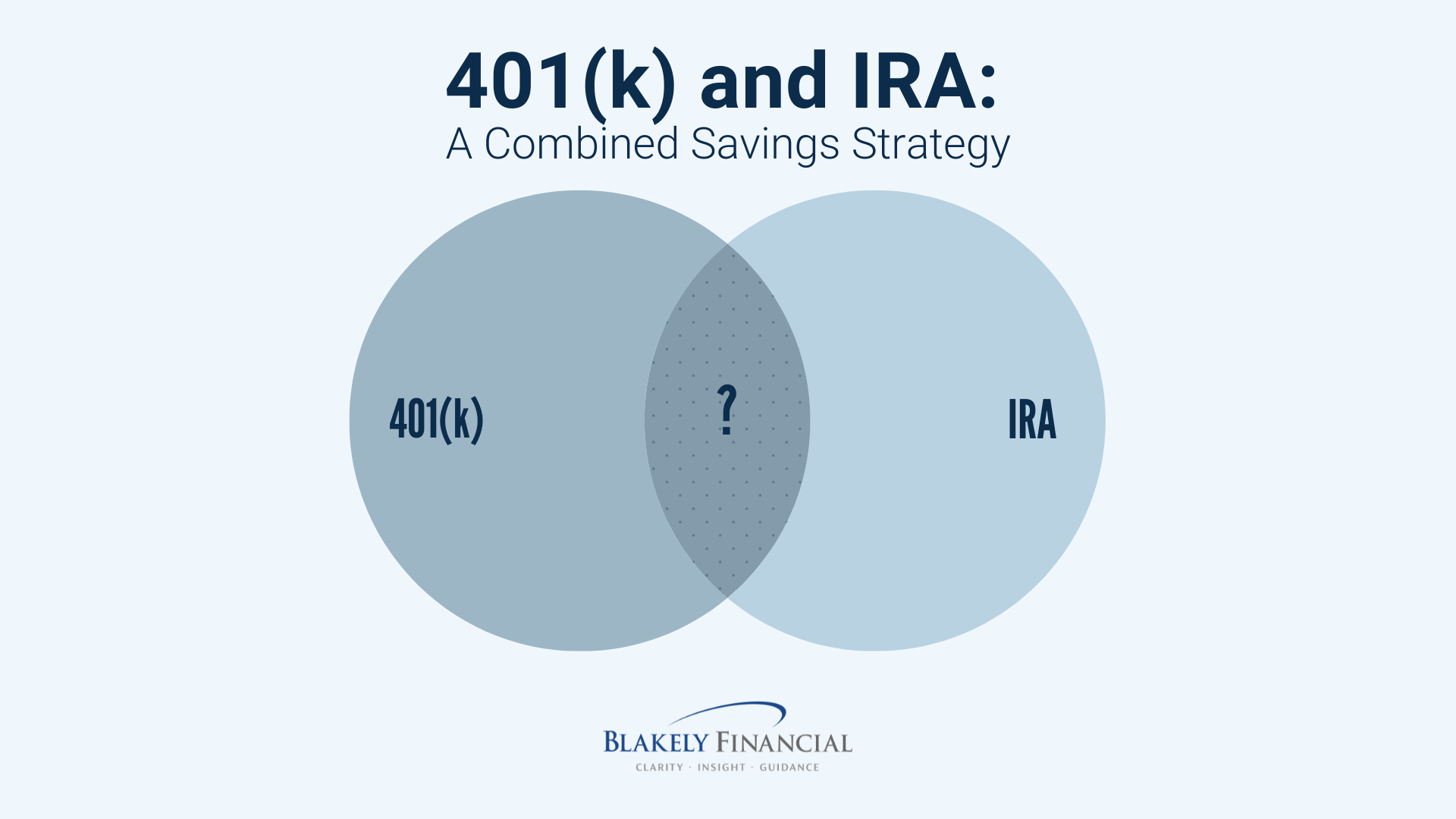
401(k) and IRA: A Combined Savings Strategy

401(k) and IRA: A Combined Savings Strategy

Contributing to an employer-sponsored retirement plan or an IRA is a big step on the road to retirement, but contributing to both can significantly boost your retirement assets. A recent study found that, on average, individuals who owned both a 401(k) and an IRA at some point during the six years of the survey had combined balances about 2.5 times higher than those who owned only a 401(k) or an IRA. And people who owned both types of accounts consistently over the period had even higher balances.1

Here is how the two types of plans can work together in your retirement savings strategy.

Convenience vs. Control

Employer-sponsored plans such as 401(k), 403(b), and 457(b) plans offer a convenient way to save through pre-tax salary deferrals, and contribution limits are high: $19,500 in 2021 ($20,500 in 2022) and an additional $6,500 if age 50 or older. Although the costs for investments offered in the plan may be lower than those provided in an IRA, these plans typically offer limited investment choices and have restrictions on control over the account.

IRA contribution limits are much lower: $6,000 in 2021 and 2022 ($7,000 if age 50 or older). But you can usually choose from a wide variety of investments, and the account is yours to control and keep regardless of your employment situation. For example, if you leave your job, you can roll assets in your employer plan into your IRA.2. In contrast, contributions to an employer plan generally must be made by December 31; you can contribute to an IRA up to the April tax filing deadline.

Matching and Diversification

Many employer plans match a percentage of your contributions. If your employer offers this program, it would be wise to contribute enough to receive the entire match. Of course, contributing more would be better, but you also might consider funding your IRA, especially if the contributions are deductible (see below).

Along with the flexibility and control offered by the IRA, holding assets in both types of accounts, with different underlying investments, could help diversify your portfolio. Diversification is a method used to help manage investment risk; it does not guarantee a profit or protect against investment loss.

Rules and Limits

Although annual contribution limits for employer plans and IRAs are separate, your ability to deduct traditional IRA contributions phases out at higher income levels if you are covered by a workplace plan: modified adjusted gross income (MAGI) of $66,000 to $76,000 for single filers and $105,000 to $125,000 for joint filers in 2021 ($68,000 to $78,000 and $109,000 to $129,000 in 2022).3 You can make nondeductible contributions to a traditional IRA regardless of income.

Eligibility to contribute to a Roth IRA phases out at higher income levels regardless of coverage by a workplace plan: MAGI of $125,000 to $140,000 for single filers and $198,000 to $208,000 for joint filers in 2021 ($129,000 to $144,000 and $204,000 to $214,000 in 2022).
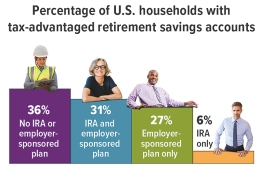
 

Source: Investment Company Institute, 2021

Contributions to employer-sponsored plans and traditional IRAs are generally made pre-tax or tax-deductible and accumulate tax-deferred. Distributions are taxed as ordinary income and may be subject to a 10% federal income tax penalty if withdrawn before age 59½ (with certain exceptions). Nondeductible contributions to a traditional IRA are not taxable when withdrawn, but any earnings are subject to ordinary income tax. Required minimum distributions (RMDs) from employer-sponsored plans and traditional IRAs must begin for the year you reach age 72 (70½ if you were born before July 1, 1949). However, you are generally not required to take distributions from an employer plan as long as you still work for that employer.

Roth IRA contributions are not deductible, but they can be withdrawn at any time without penalty or taxes. To qualify for the tax-free and penalty-free withdrawal of earnings, Roth IRA distributions must meet a five-year holding requirement and take place after age 59½ (with certain exceptions). Original owners of Roth IRAs are exempt from RMDs. However, beneficiaries of all IRAs and employer plans must take RMDs based on their age and relationship to the original owner.

1) Employee Benefit Research Institute, 2020

2) Other options when separating from an employer include leaving the assets in your former employer’s plan (if allowed), rolling them into a new employer’s plan, or cashing out (usually not wise).

3) If a workplace plan does not cover you, but your spouse is covered, eligibility phases out at MAGI of $198,000 to $208,000 for joint filers in 2021 ($204,000 to $214,000 in 2022).


This material has been provided for general informational purposes only and does not constitute either tax or legal advice. Although we go to great lengths to ensure our information is accurate and useful, we recommend you consult a tax preparer, professional tax advisor, or lawyer.

Engage with the entire Blakely Financial team at WWW.BLAKELYFINANCIAL.COM to see what other financial tips we can provide towards your financial well-being.

Blakely Financial, Inc. is an independent financial planning and investment management firm that provides clarity, insight, and guidance to help our clients attain their financial goals.

Securities and advisory services offered through Commonwealth Financial Network, Member FINRA/SIPC, a Registered Investment Adviser.


Women Face Challenges in a Post-Pandemic World Emily Promise Blakely Financial

Women Face Challenges in a Post-Pandemic World

By Emily Promise,  CFP®, CDFA®, AIF®, APMA®, CRPC®

The COVID-19 economic crisis tested the mettle of all Americans, mainly working mothers. Research shows that the pandemic’s impacts on women have been far-reaching and potentially long-lasting. Now that the U.S. economy is picking up steam, it may be more important than ever for women to re-examine their retirement planning strategies.

Effects of the COVID-19 Economy

The COVID-19 recession disproportionately impacted working women because sectors that typically employ them — including retail, hospitality, and health care — were hit harder than others. As noted in a paper released by the National Bureau of Economic Research, “Employment fell more for women compared to men at every stage during the pandemic, with the biggest gender differences estimated for married women with children.” Many women were forced to cut work hours or leave jobs entirely to care for family members and supervise remote schooling activities when daycares and schools shut down.1

In a Pew Research study, 64% of women said they or someone in their household lost a job or took a pay cut during the pandemic, and nearly a quarter took unpaid time off for personal, family, or medical reasons. Half of women ranked their financial situation as “only fair” or “poor.”2

More Than Their Share of Job Losses
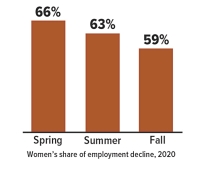
Before the pandemic, women made up 52% of the population. Yet, they represented a more significant proportion of the employment decline during the spring, summer, and fall seasons of 2020.
Women’s share of the 2020 employment decline: spring 66%; summer 63%; fall 59%.
Source: National Bureau of Economic Research, 2021

Retirement at Risk?

When it comes to retirement savings, unmarried women have the most ground to cover, according to an Employee Benefit Research Institute survey. Nearly six in 10 have less than $50,000 set aside for retirement; 31% have saved less than $1,000.3

Couple these statistics with the retirement planning challenges women faced even before the pandemic — longer life spans and lower earnings and Social Security benefits, on average — and it’s apparent that women need a carefully considered retirement strategy that will help them pursue their goals.

Making Up Lost Ground

If you or a loved one need to make up lost ground, consider the following tips.

1. Save as much as possible in tax-advantaged investment vehicles, such as employer-based retirement plans and IRAs. In 2021, you can contribute up to $19,500 to 401(k) and similar plans and $6,000 to IRAs. Those figures jump to $26,000 and $7,000, respectively, if you are 50 or older. If your employer offers a match, be sure to contribute at least enough to take full advantage of it. If you have no income but you’re married and file a joint income tax return, you can still contribute to a spousal IRA in your name, provided your spouse earns at least as much as you contribute.

2. Familiarize yourself with basic investing principles: dollar-cost averaging, diversification, and asset allocation. Dollar-cost averaging involves continuous investments in securities, regardless of fluctuating prices, and can be an effective way to accumulate shares to help meet long-term goals. However, you should consider your financial ability to continue making purchases during periods of low and high price levels. (If you contribute to an employer-based plan, you’re already using dollar-cost averaging.) Diversification and asset allocation are methods to help manage investment risk while building a portfolio appropriate for your needs. Note that all investment involves risk, and none of these strategies guarantees a profit or protects against investment loss.

3. Seek guidance from your financial professional, who can provide an objective opinion during challenging times and may be able to help you find ways to reduce costs and save more. Although there is no assurance that working with a financial professional will improve investment results, a professional can evaluate your objectives and available resources and help you consider appropriate long-term financial strategies.

Sources: 1) National Bureau of Economic Research, 2021; 2) Pew Research Center, 2021; 3) Employee Benefit Research Institute, 2021

This material has been provided for general informational purposes only and does not constitute either tax or legal advice. Although we go to great lengths to make sure our information is accurate and useful, we recommend you consult a tax preparer, professional tax advisor, or lawyer.

Engage with the entire Blakely Financial team at WWW.BLAKELYFINANCIAL.COM to see what other specialized advice we can provide towards your financial well-being.

EMILY PROMISE is a financial advisor with BLAKELY FINANCIAL, INC. located at 1022 Hutton Ln., Suite 109, High Point, NC 27262 and can be reached at (336) 885-2530.

Blakely Financial, Inc. is an independent financial planning and investment management firm that provides clarity, insight, and guidance to help our clients attain their financial goals.

Securities and advisory services offered through Commonwealth Financial Network, Member FINRA/SIPC, a Registered Investment Adviser.
Prepared by Commonwealth Financial Network®

Beneficiary Planning

Beneficiary Planning: What You Need to Know

Presented by Robert C. Blakely 


Designating a beneficiary on retirement accounts is one of the most important—yet one of the most frequently neglected—retirement and financial planning tasks. Oftentimes people forget to update beneficiaries after major life events. A beneficiary is any person or entity that an account owner chooses to receive the benefits of a retirement account in the event the account owner dies.

Here are some important factors to consider when selecting beneficiaries for your retirement accounts:

  1. Don’t leave a beneficiary form blank, and don’t name your estate as beneficiary. Failing to name an individual, or individuals, as your beneficiary could deprive your heirs or loved ones of inheriting your retirement assets. Another downside of not naming a beneficiary: your retirement assets would need to go through the lengthy probate process and could be subject to creditors.


  1. Make a beneficiary designation for each retirement account that you own. People often make the mistake of assuming that the beneficiary they name on one account will dictate who the beneficiary is on their other retirement accounts, but that is not the case. You need to have a valid beneficiary on file for each account.


  1. Remember that beneficiary designations take precedence over wills. Retirement assets are distributed according to the named beneficiary, regardless of any other agreements, such as wills.


  1. Keep your beneficiary designations current. Many people fail to update their beneficiary designations after major life events, such as a marriage, divorce, or new addition to the family.


  1. Consider consulting a professional. You may wish to seek the guidance of an experienced attorney, CPA, or financial advisor to help you make the best choices for you and your heirs.


This material has been provided for general informational purposes only and does not constitute either tax or legal advice. Although we go to great lengths to make sure our information is accurate and useful, we recommend you consult a tax preparer, professional tax advisor, or lawyer.

Engage with the entire Blakely Financial team at WWW.BLAKELYFINANCIAL.COM to see what other expert advice we can provide towards your financial well-being.

ROBERT BLAKELY, CFP® is a financial advisor with BLAKELY FINANCIAL, INC. located at 1022 Hutton Ln., Suite 109, High Point, NC 27262. He is the founder and president of Blakely Financial, Inc.

Blakely Financial, Inc. is an independent financial planning and investment management firm that provides clarity, insight, and guidance to help our clients attain their financial goals.

Securities and advisory services offered through Commonwealth Financial Network, Member FINRA/SIPC, a Registered Investment Adviser.

Diversification and asset allocation programs do not assure a profit or protect against loss in declining markets, and cannot guarantee that any objective or goal will be achieved.

Financial Wellness In The New Year

Financial Wellness In The New Year

Presented by STEPHEN LAFRANCE, CFP®, MBA

With the new year comes all sorts of resolutions and goal setting. It is excellent to vow to lose weight, eat healthier, spend more time with your family, etc. but have you taken inventory of your finances and your financial goals? Many of us have probably overspent during the holidays, and it is time to get ahold of our financial health and resolve to get our finances in check.

Achieving money–related balance and financial wellness isn’t necessarily about investing a set dollar amount or your ability to pay for something expensive without flinching. It is much broader. It is about getting your entire house in order. It can be as simple as chatting about starting your travel fund, saving $20 a month, or whether or not your company offers a 401(k) match. Financial independence allows us to live the life that we want. It is about developing a healthy relationship with money and feeling a sense of control over short-term obligations while working toward those long-term goals.

An essential first step towards financial wellness is actively talking about your finances. That is not to say you have to divulge personal details about your savings and debt to your whole group of friends, but choosing a mentor or meeting with a financial advisor to put together an action plan can help.

Here are some tips to help get you on the path to financial wellness.

  • Develop goals and identify priorities.
  • Assess your current assets and resources.
  • Identify any barriers to achieving your goals. For example, if you have student debt or large balances on credit cards, tackle these. Then, work with a credit counselor to consolidate your debt and make it more manageable to pay off.
  • Incorporate strategies into your plan like brewing your coffee and preceding that $3 cup from the local chain coffee shop. It’s incredible how small steps add up fast.
  • Put your plan into action. Start saving more for your retirement. Even if it increases your contribution to your 401(k) by just 1% each year, the long-term benefit of this will surprise you.
  • Consider looking into long-term care insurance. According to the statistics, we are all living longer, and more than 70 percent of Americans will require some care in their later years. Talk to your financial advisor today and see which LTC coverage is best for you.
  • Monitor your progress, evaluate where you are, and adjust your plan as necessary.

Good planning and consulting with a financial advisor can take some stress out of your life and get you on the path to financial wellness today!

Engage with the entire Blakely Financial team at WWW.BLAKELYFINANCIAL.COM to see what other financial tips we can provide towards your financial well-being.

STEPHEN LAFRANCE, CFP®, MBA is a financial advisor with BLAKELY FINANCIAL, INC. located at 1022 Hutton Ln., Suite 109, High Point, NC 27262. 336-885-2530.

Blakely Financial, Inc. is an independent financial planning and investment management firm that provides clarity, insight, and guidance to help our clients attain their financial goals.

Securities and advisory services offered through Commonwealth Financial Network, Member FINRA/SIPC, a Registered Investment Adviser.

Outlook 2021

Outlook 2021: Where We Are and Where We’re Headed
Presented by Robert Blakely, CFP®, AIF®, ChFC

As we approach the beginning of a new year and consider what it may bring, it is helpful to reflect on the one now behind us. After what has been a tumultuous year of unbelievable events and unprecedented circumstances, we have made it to a point where there may actually be more good news than bad. The election is behind us. Vaccines look to be more effective than anyone expected. Jobs and confidence are holding up surprisingly well as the economy adapts. Although the third wave continues to worsen, and many people will face a financial cliff at the end of the year as subsidies expire, more good than bad seems to be what markets are banking on.

In today’s environment, it’s hard to predict what might happen next, but we do know enough to make some educated guesses. The biggest call is simply this: that next year will be much better than this year.

What Things Look Like Today
On the medical front, there are signs the third wave is starting to peak. With many states now implementing mask requirements and shutdowns, we should bring the pandemic back under control in the next couple of months. And as the third wave recedes, we should see the first wave of vaccinations start. Given what we know today, we can have some confidence that the virus will start to move from an urgent problem to a chronic but manageable one sometime in the first half of the year.

From an economic standpoint, the news is even better. Right now, growth is still positive even as the third wave crests. Job growth continues to be substantially higher than what we saw before the pandemic, indicating our economy is healing and adapting. Consumer confidence is holding up, supported by the improving job climate. Retail spending has recovered to new highs and continues to grow. And as the medical news improves, we can expect to see both confidence and spending grow even faster.

With the consumer economy resilient and likely to improve with the medical news, business should also do well. Business confidence is already above the levels seen before the pandemic and in 2019. Business investment dropped off in early 2020, but it has been recovering and should move back to growth. With rising consumer demand, those trends may accelerate as well.

The last major component of the economy, government spending, is the wild card. The big question will be whether there is another stimulus package. Right now, prospects appear good. Where a stimulus package would help most is at lower levels of government. Both state and local governments have seen revenues fall, and since they cannot run deficits, they respond to revenue shortfalls by laying local government workers off. Help from the federal government would save those jobs and their purchasing power, and that could provide a substantial tailwind over the next quarter or so. Without such stimulus, the government could be a roadblock to total growth.

Another piece of the puzzle for 2021 is monetary policy. The Federal Reserve (Fed) has been extremely accommodating of the economy, keeping interest rates low, and that is likely to continue through 2021. With inflation still low, there will be little pressure for the Fed to raise rates anyway.

What This Means for 2021
Overall, the strength of the consumer and business sectors should help carry us forward, supported by the Fed’s low-interest-rate policy. Declines in government spending, if not countered by a federal stimulus, are the principal risk here. All things considered, though, we should see faster growth throughout 2021.

Markets have been cheering the vaccine news, as well as economic resilience. If things go as expected, markets still have room to appreciate further through 2021, although their path is unlikely to be as smooth. When the inevitable setbacks hit, we will see more volatility throughout the next year.

And that takes us to the risks and uncertainties. For the pandemic, the primary assumption is that the virus will be brought under control in 2021. This means that the vaccines must work, they must be widely available in the next six months, and enough people must be willing to take them. These are reasonable assumptions, but nothing is guaranteed.

For the economy, the primary assumption is that once enough people are vaccinated, the economy will return to something close to normal. Despite many changes—working from home, less travel, more online shopping—consumers and the economy are adapting. Although the new normal will not be exactly like the old, it will likely be normal enough. How fast we get there, though, is uncertain.

There are real risks here, but macro indicators are already suggesting we may be moving out of the recession. If those risks do materialize, we’ll likely see a somewhat slower recovery, but not a collapse. Even if things get worse, we’ll still be moving forward.

It Can Only Get Better from Here
From where we stand in late 2020, the prospects for 2021 remain positive. The healing process—for public health, the economy, and what will become our new normal—will not necessarily be smooth or without setbacks, but it will continue. This year did not go as we expected it to at the start, but our position now is much better than it could have been under the circumstances. We’re making progress, but it takes time. And that will be the story of 2021.

Disclosures: Certain sections of this commentary contain forward-looking statements that are based on our reasonable expectations, estimates, projections, and assumptions. Forward-looking statements are not guarantees of future performance and involve certain risks and uncertainties, which are difficult to predict. All indices are unmanaged and are not available for direct investment by the public. Past performance is not indicative of future results. Diversification does not assure a profit or protect against loss in declining markets. The S&P 500 is based on the average performance of the 500 industrial stocks monitored by Standard & Poor’s. Emerging market investments involve higher risks than investments from developed countries, as well as increased risks due to differences in accounting methods, foreign taxation, political instability, and currency fluctuation.

###

Blakely Financial, Inc. is located at 1022 Hutton Lane Suite 109, High Point, NC 27262 and can be reached at 336-885-2530.
Securities and Advisory Services offered through Commonwealth Financial Network, Member FINRA/SIPC, a Registered Investment Adviser. Fixed insurance products and services offered through CES Insurance Agency or Blakely Financial, Inc.

© 2020 Commonwealth Financial Network®

Family Finance Meetings

Authored by ROBERT BLAKELY, CFP®, AIF®, CHFC®

Holiday gatherings are an opportunity for families to grow closer to each other and to build life long memories. It’s also a great excuse to schedule and discuss financial well-being and preparedness since important topics like this are often overlooked. As a financial planning firm, we often schedule periodic reviews with our clients throughout the year to plan, reassess strategies, and refine direction based on changes to our client’s needs. So, wouldn’t it make sense for families to have the same conversations with each other?

You work hard to teach your kids what they need to become well-rounded and successful adults. You teach them which foods are good for them, how to play fairly with friends, and encourage them to build a strong work ethic and moral compass. You do these things because you recognize that the lessons, they learn today will ripple outwards through their lives as they move on to their own careers, their own families, and their own challenges.

Why not work just as hard to teach your family to build strong financial habits?

Letting these difficult conversations slide may be easier, but when you rob your children of their ability to learn from your mistakes, you doom them to learn from experience. The cost of poor money decisions your child makes in their twenties could permanently dampen their lifetime earning potential and set them back decades. Families who make a concerted effort to have financial discussions and pass on healthy habits have a better opportunity to grow financially stronger than those who avoid the talk.

Family finance meetings aren’t just for those of us with kids, however. Statistics tell us that one in five couples who filed for divorce last year cited finances as the reason that they split. Whether we like to admit it or not, money plays a role in just about every aspect of our lives. Your financial resources will directly impact the vacations you take, the insurances and protection you can afford, the opportunities you can provide to your spouse, and everything in between. You and your significant other can stay in sync on spending and other related finances by having regular healthy planning discussions.

How do we broach what sometimes can be difficult financial subjects with loved ones? The simple answer, like most things in finance, is that there is no one size fits all solution. Not only do people, and their family relationships differ greatly between individuals, but the value itself is subjective. What’s important to one family may be far down on the list for another. What one couple might find to be a perfect solution could create additional stress for another. The answer starts with open and honest communication. That’s how we approach it with our clients at Blakely Financial.

Create an environment where each member of the family can discuss where the finances are today, and where they would like them to be in the future. For couples, try sitting down once a month, opening a bottle of wine, and reviewing the credit card statement. Create a judgment-free zone, where line by line you review spending habits and come to an agreement on things you’d like to do more or less of. Keep in mind that the objective here is not necessarily creating a budget or identifying wasteful spending, it’s simply to recognize and reconcile each person’s view of the family’s finances.

Financial teamwork strengthens bonds by cultivating a sense of camaraderie and a mutual appreciation for each other’s work. If you and your spouse can calmly and openly discuss spending and savings habits, you will be well on your way to not only financial balance but a healthy happy relationship. Seeking advice and guidance from a financial professional is also a great addition to the conversation. This will quickly set yourself apart from the average American household.

For those with children, discussing dollars and cents may seem a little more difficult if the people at the table are more worried about superheroes and sleepovers than they are with financial responsibility. Once again this will need to be a discussion that couples have together on how best to involve children in the family finances. Keeping everyone at the table after dinner to discuss a savings goal may be a good place to start. Beginning with something tangible, a reward even, may also lead to some interesting discussion.

Bring the family together to decide on where next year’s vacation might be, discuss the costs associated, and in simple terms draw up a savings goal for your trip. Each month discuss how much you were able to save, how much you have set aside, and how close you are to achieving your goal. Encourage your children to contribute small allowances and thank them for doing so. When trip time comes around, recognize that you are only able to enjoy this experience because of the hard work and patience you showed in saving up.

Something as simple as creating a basic family budget, where monthly amounts are discussed amongst everyone at the table can begin to introduce your children to the concept of planning out income and expenses ahead of time rather than taking them on as they come. In an era where most families are living paycheck to paycheck, you will be giving your children a head start to communicating about finances. As many people learn the hard way, we inherit many of our habits and behaviors from our parents, good and bad. Even if your children are only loosely connected to the discussion, they will be internalizing some very important skills. You will be giving them exposure to prudence, cooperation, and communication, valuable traits that will serve them well for the rest of their lives, and their children’s lives.

The importance of having a family finance conversation cannot be understated. Money is threaded through everything that you and your family hope to do in your lives, and it can make or break you. Don’t procrastinate or let tensions boil over concerning finances. Be a family that cooperates and plans together. This holiday season schedule in a “Family Financial Meeting”. You will be able to experience more, together, for generations to come.

Engage with the entire Blakely Financial team at WWW.BLAKELYFINANCIAL.COM to see what other financial tips we can provide towards your financial well-being.

ROBERT BLAKELY, CFP® is a financial advisor with BLAKELY FINANCIAL, INC. located at 1022 Hutton Ln., Suite 109, High Point, NC 27262. He is the founder and president of Blakely Financial, Inc. celebrating 25 years in business.

Blakely Financial, Inc. is an independent financial planning and investment management firm that provides clarity, insight, and guidance to help our clients attain their financial goals.

Securities and advisory services offered through Commonwealth Financial Network, Member FINRA/SIPC, a Registered Investment Adviser.

Best Practices When Saving For Retirement

Presented by ROBERT BLAKELY, CFP®, AIF®, CHFC®

It is “Save for Retirement Week.” One essential step in saving for retirement is to start as early as possible. It is more fun to get instant gratification from buying that five-dollar coffee or those fancy new designer shoes, but sometimes stepping back and thinking about your future goals will stop you from making a decision that may hurt you. Starting early and being disciplined will help you reach your goals and make retirement more enjoyable.

Write Your Goals Down

We suggest that you begin by writing down your financial goals. Writing them down makes it more likely to stay the course and achieve those goals. Meeting with a financial advisor to develop a strategy to achieve your goals is significant. And revisiting these goals often will keep you committed, driven, and on track.

Participate in Company’s 401(k)

One of the most important financial planning strategies in saving for retirement is to contribute to your company’s retirement plan and be sure to maximize your employer’s 401(k) match. Participating in your company’s plan and taking advantage of that extra money that is matched will help to accelerate your growth potential and get you on the road to a comfortable retirement.

Stay On Budget

Another crucial step in saving for retirement is staying within your budget. Budgeting is vital this time of year, with the holidays upon us and the temptations to purchase extras throughout the next couple of months. So often, we get caught up in the holiday spirit and forget about our bills during this time. To ensure that you do not overspend this season now is the perfect time to create a realistic holiday spending budget that won’t break the budget.

Saving for retirement does not have to be complicated. Start early, identify your goals, stay on budget, and maximize any matching money available to you, and you will be on the road to achieving your dreams and goals. And as always, meeting with your financial advisor will help you stick with your plan.

Engage with the entire Blakely Financial team at WWW.BLAKELYFINANCIAL.COM to see what other financial tips we can provide towards your financial well-being.

ROBERT BLAKELY, CFP® is a financial advisor with BLAKELY FINANCIAL, INC., located at 1022 Hutton Ln., Suite 109, High Point, NC 27262. He is the founder and president of Blakely Financial, Inc. celebrating 25 years in business.

Blakely Financial, Inc. is an independent financial planning and investment management firm that provides clarity, insight, and guidance to help our clients attain their financial goals.

Securities and advisory services offered through Commonwealth Financial Network, Member FINRA/SIPC, a Registered Investment Adviser.

What To Do With Your 401(k) After A Job Change

Presented by ROBERT BLAKELY, CFP®, AIF®, CHFC®

If you have lost your job, or are changing jobs, you may be wondering what to do with your 401(k) plan. Our team at Blakely Financial feels that it is important to understand your options.

For starters, many ask, “What will I be entitled to?”

If you leave your job (voluntarily or involuntarily), you will be entitled to a distribution of your vested balance. Your vested balance always includes your own contributions (pre-tax, after-tax, and Roth) and typically any investment earnings on those amounts. It also includes employer contributions (and earnings) that have satisfied your company plan’s vesting schedule.

In general, you must be 100% vested in your employer’s contributions after 3 years of service (“cliff vesting”), or you must vest gradually, 20% per year until you are fully vested after 6 years (“graded vesting”). Plans can have faster vesting schedules, and some even have 100% immediate vesting. You will also be 100% vested once you have reached your plan’s normal retirement age.

It is important for you to understand how your particular plan’s vesting schedule works because you will forfeit any employer contributions that have not vested by the time you leave your job. Your summary plan description (SPD) will spell out how the vesting schedule for your particular plan works. If you do not have one, ask your plan administrator for it. If you are on the cusp of vesting, it may make sense to wait a bit before leaving, if you have that luxury.

Make sure you do not spend it.

While this pool of dollars may look attractive, do not spend it unless you absolutely need to. If you take a distribution you will be taxed, at ordinary income tax rates, on the entire value of your account except for any after-tax or Roth 401(k) contributions you have made. And, if you are not yet age 55, an additional 10% penalty may apply to the taxable portion of your payout. (Special rules may apply if you receive a lump-sum distribution and you were born before 1936, or if the lump-sum includes employer stock.)

If your vested balance is more than $5,000, you can leave your money in your employer’s plan at least until you reach the plan’s normal retirement age (typically age 65). But your employer must also allow you to make a direct rollover to an IRA or to another employer’s 401(k) plan. As the name suggests, in a direct rollover the money passes directly from your 401(k) plan account to the IRA or other plan. This is preferable to a “60-day rollover,” where you get the check and then roll the money over yourself because your employer has to withhold 20% of the taxable portion of a 60-day rollover. You can still roll over the entire amount of your distribution, but you will need to come up with the 20% that’s been withheld until you recapture that amount when you file your income tax return.

Should I roll over to my new employer’s 401(k) plan or to an IRA?

Assuming both options are available to you, there is no right or wrong answer to this question. There are strong arguments to be made on both sides. You need to weigh all of the factors and make a decision based on your own needs and priorities. It is best to consult with your financial advisor, since the decision you make may have significant consequences — both now and in the future.

Reasons to consider rolling over to an IRA:

You generally have more investment choices with an IRA than with an employer’s 401(k) plan. You typically may freely move your money around to the various investments offered by your IRA trustee, and you may divide up your balance among as many of those investments as you want. By contrast, employer-sponsored plans generally offer a limited menu of investments (usually mutual funds) from which to choose.

You can freely allocate your IRA dollars among different IRA trustees/custodians. There is no limit on how many direct, trustee-to-trustee IRA transfers you can do in a year. This gives you the flexibility to change trustees often if you are dissatisfied with investment performance or customer service. It can also allow you to have IRA accounts with more than one institution for added diversification. With an employer’s plan, you cannot move the funds to a different trustee unless you leave your job and roll over the funds.

An IRA may give you more flexibility with distributions. Your distribution options in a 401(k) plan depend on the terms of that particular plan, and your options may be limited. However, with an IRA, the timing and amount of distributions are generally at your discretion (until you reach age 72 and must start taking required minimum distributions in the case of a traditional IRA).

You can roll over (essentially “convert”) your 401(k) plan distribution to a Roth IRA. You will generally have to pay taxes on the amount you roll over (minus any after-tax contributions you have made), but any qualified distributions from the Roth IRA in the future will be tax-free.

Reasons to consider rolling over to your new employer’s 401(k) plan (or stay in your current plan):

Many employer-sponsored plans have loan provisions. If you roll over your retirement funds to a new employer’s plan that permits loans, you may be able to borrow up to 50% of the amount you roll over if you need the money. You can’t borrow from an IRA — you can only access the money in an IRA by taking a distribution, which may be subject to income tax and penalties. (You can give yourself a short-term loan from an IRA by taking a distribution, and then rolling the dollars back to an IRA within 60 days; however, this move is permitted only once in any 12-month time period.)

Employer retirement plans generally provide greater creditor protection than IRAs. Most 401(k) plans receive unlimited protection from your creditors under federal law. Your creditors (with certain exceptions) cannot attach your plan funds to satisfy any of your debts and obligations, regardless of whether you have declared bankruptcy. In contrast, any amounts you roll over to a traditional or Roth IRA are generally protected under federal law only if you declare bankruptcy. Any creditor protection your IRA may receive in cases outside of bankruptcy will generally depend on the laws of your particular state. If you are concerned about asset protection, be sure to seek the assistance of a qualified professional.

You may be able to postpone the required minimum distributions (RMDs). For traditional IRAs, these distributions must begin by April 1 following the year you reach age 72. However, if you work past that age and are still participating in your employer’s 401(k) plan, you can delay your first distribution from that plan until April 1 following the year of your retirement. (You also must own no more than 5% of the company.) Currently, due to the Coronavirus Aid, Relief, and Economic Security (CARES) Act, required minimum distributions (RMDs) are waived in 2020. Make sure to check with your advisor and tax preparer for more information.

If your distribution includes Roth 401(k) contributions and earnings, you can roll those amounts over to either a Roth IRA or your new employer’s Roth 401(k) plan (if it accepts rollovers). If you roll the funds over to a Roth IRA, the Roth IRA holding period will determine when you can begin receiving tax-free qualified distributions from the IRA. So if you’re establishing a Roth IRA for the first time, your Roth 401(k) dollars will be subject to a brand new five-year holding period. On the other hand, if you roll the dollars over to your new employer’s Roth 401 (k) plan, your existing five-year holding period will carry over to the new plan. This may enable you to receive tax-free qualified distributions sooner.

When evaluating whether to initiate a rollover always be sure to (1) ask about possible surrender charges that may be imposed by your employer plan, or new surrender charges that your IRA may impose, (2) compare investment fees and expenses charged by your IRA (and investment funds) with those charged by your employer plan (if any), and (3) understand any accumulated rights or guarantees that you may be giving up by transferring funds out of your employer plan.

What about outstanding plan loans?

In general, if you have an outstanding plan loan, you will need to pay it back, or the outstanding balance will be taxed as if it had been distributed to you in cash. If you cannot pay the loan back before you leave, you will still have 60 days to roll over the amount that has been treated as a distribution to your IRA. Of course, you will need to come up with the dollars from other sources.

Losing a job or making that change to a new one comes with a lot of stress and unknowns. Being aware of your options when it comes to your 401(k) plan will help alleviate some of that stress. And as always, when you are facing big life changes and entering new chapters in your life, our team at Blakely Financial recommends a review with your financial advisor to make sure you account for these life changes and your future financial plan and goals.


Engage with the entire Blakely Financial team at WWW.BLAKELYFINANCIAL.COM to see what other financial tips we can provide towards your financial well-being.

ROBERT BLAKELY, CFP® is a financial advisor with BLAKELY FINANCIAL, INC. located at 1022 Hutton Ln., Suite 109, High Point, NC 27262. He is the founder and president of Blakely Financial, Inc. celebrating 25 years in business.

Blakely Financial, Inc. is an independent financial planning and investment management firm that provides clarity, insight, and guidance to help our clients attain their financial goals.

Securities and advisory services offered through Commonwealth Financial Network, Member FINRA/SIPC, a Registered Investment Adviser.

Prepared By Broadridge Advisor Solutions